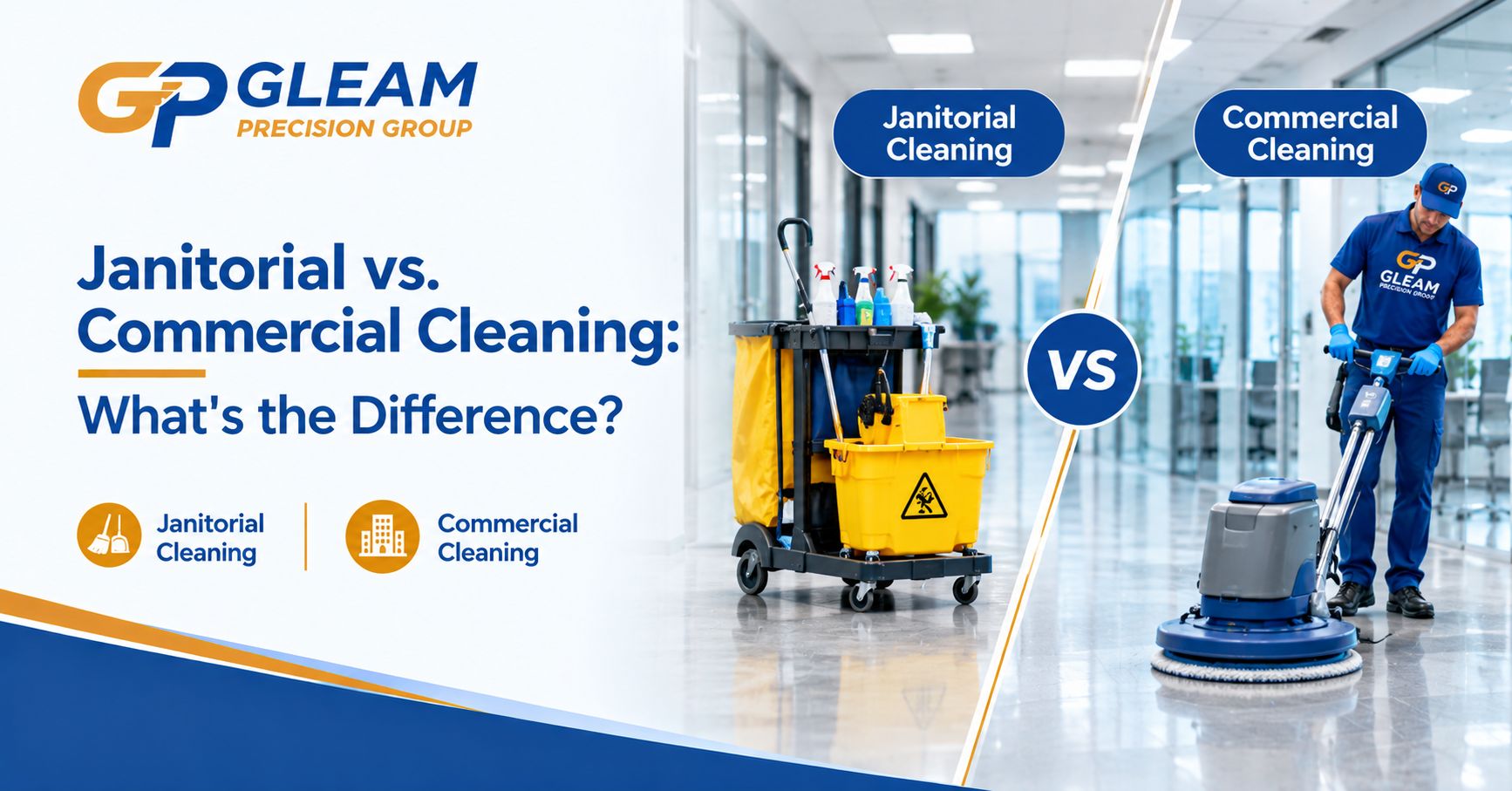
Keeping a workplace clean is about more than making a good first impression. A properly maintained business environment supports employee comfort, creates a welcoming experience for visitors and helps maintain a professional image. However, when researching cleaning solutions, business owners often encounter two terms: janitorial cleaning and commercial cleaning. Although they are closely related, they do not always describe the same scope of work.
So, what is the difference between janitorial and commercial cleaning?
Janitorial cleaning generally refers to routine, ongoing cleaning and maintenance tasks performed to keep a workplace tidy and hygienic. Commercial cleaning is a broader term that can include routine cleaning as well as specialized, periodic and more intensive cleaning services for business properties.
Understanding the distinction can help you choose a cleaning arrangement that matches your building, daily operations and maintenance requirements.
At Gleam Precision Group, businesses can explore professional cleaning solutions designed to help maintain cleaner, more presentable spaces. Here is what you should know about janitorial and commercial cleaning before choosing a service.
Janitorial cleaning is the regular cleaning and upkeep of commercial and professional spaces. It focuses on maintaining cleanliness through scheduled tasks that prevent everyday dirt, dust, waste and mess from accumulating.
These services are often performed daily, several times a week or according to an agreed maintenance schedule. The frequency depends on the property's size, number of occupants, business activities and cleaning requirements.
A janitorial cleaning plan may include:
For example, an office with employees working throughout the day may need regular washroom cleaning, waste removal, floor maintenance and surface cleaning. These recurring tasks help the workplace remain presentable and comfortable.
Janitorial services are suitable for many types of facilities, including:
The main objective is consistency. Rather than waiting until a property becomes noticeably dirty, janitorial cleaning maintains an acceptable level of cleanliness through routine attention.
Businesses looking for ongoing maintenance can explore janitorial services to understand the role of scheduled cleaning in maintaining commercial spaces.
Also Read:
Deep Cleaning Before an Audit, Inspection or Grand Opening
Commercial cleaning is a broad category of cleaning services provided for business premises and other non-residential properties. It can include routine maintenance, but it may also cover specialized cleaning tasks that are not necessarily performed every day.
The exact scope depends on the building and the service agreement. A commercial cleaning program may combine recurring cleaning with occasional deep cleaning, floor care, carpet cleaning or window cleaning.
Depending on the property's needs, commercial cleaning may involve:
For instance, a business may arrange regular cleaning to maintain its office while scheduling carpet extraction or detailed floor cleaning periodically. These services address different cleaning needs but can form part of one overall maintenance strategy.
Businesses comparing broader cleaning options can review commercial cleaning services to explore solutions for maintaining professional environments.
The biggest difference is the scope and purpose of the work. Janitorial cleaning is usually focused on recurring maintenance, while commercial cleaning can include a wider selection of routine and specialized services.
Here is a practical comparison:
| Comparison | Janitorial Cleaning | Commercial Cleaning |
|---|---|---|
| Main purpose | Maintain everyday cleanliness | Maintain and improve overall property cleanliness |
| Frequency | Usually daily or regularly scheduled | Routine, periodic or project-based |
| Typical tasks | Waste removal, washroom cleaning, dusting and mopping | General cleaning, deep cleaning, floor care, carpet and window cleaning |
| Scope | Primarily ongoing maintenance | Broad range of cleaning requirements |
| Scheduling | Often recurring | Recurring or occasional |
| Best suited for | Facilities needing consistent daily upkeep | Businesses needing routine and specialized cleaning |
| Cleaning focus | Preventing everyday dirt and mess | Addressing both routine and more intensive cleaning needs |
It is important to understand that these categories overlap. A commercial cleaning company may provide janitorial services as part of its service offering. Similarly, a janitorial agreement may include additional tasks depending on the property's requirements.
The terms are not always used consistently across the cleaning industry. Therefore, businesses should compare the actual tasks, frequency and service responsibilities rather than relying on the service name alone.
Choosing between janitorial and commercial cleaning depends on how your property is used and what needs to be maintained.
Consider these common business situations.
An office with employees, clients and visitors moving through the building throughout the day will usually benefit from recurring janitorial maintenance.
Important tasks may include:
A consistent schedule helps prevent everyday dirt and clutter from affecting the workplace.
Businesses that need a dedicated solution for their office environment can explore office cleaning services.
A commercial property may look reasonably clean after routine maintenance but still require attention in less frequently cleaned areas.
For example, carpets can gradually collect dust and debris, floors may develop stubborn marks, and windows can accumulate visible buildup.
These situations may require additional commercial cleaning services, such as deep cleaning, carpet care or floor maintenance.
Businesses sometimes need more than their usual cleaning schedule before an inspection, client presentation, special event or important visitor arrival.
A more detailed cleaning appointment can address areas that may not be covered during routine maintenance.
The appropriate tasks will depend on the building's condition and the areas requiring attention.
Routine cleaning is an important part of managing a commercial property. It helps businesses maintain a consistent standard instead of allowing everyday mess to accumulate.
Clean floors, tidy common areas and maintained washrooms contribute to a professional appearance. This can influence how employees, clients and visitors perceive a business.
Frequently used surfaces and shared spaces can collect dirt throughout the day. Regular cleaning and appropriate sanitizing practices help maintain a cleaner environment.
Small cleaning tasks can become larger maintenance concerns when neglected. Routine attention helps businesses identify and address everyday cleanliness issues before they become more difficult to manage.
When cleaning responsibilities are handled through an organized service schedule, employees can spend less time dealing with general workplace upkeep.
The specific benefits depend on the cleaning plan, the property's use and how consistently the service is delivered.
Also Read:
Daytime vs. After-Hours School Cleaning: Which Works Better?
Commercial cleaning provides businesses with access to a broader range of cleaning tasks. It can be particularly useful when a property requires more than routine upkeep.
Different materials require different cleaning methods. Carpets, hard floors, glass and upholstery may need specific equipment and products.
For example, professional carpet cleaning can address dirt and buildup that regular vacuuming may not remove.
Some areas need periodic detailed attention beyond everyday cleaning. A deep cleaning service can help address accumulated dirt in selected areas and support a more comprehensive cleaning routine.
Commercial floors experience regular foot traffic, which can contribute to visible dirt, marks and wear. Depending on the flooring material, professional maintenance may involve appropriate scrubbing and cleaning methods.
Businesses can learn more about commercial floor cleaning when evaluating their floor maintenance requirements.
Windows, glass partitions and entrance doors are highly visible parts of many commercial properties. Periodic window cleaning can help maintain a clearer, more professional appearance.
There is no universal answer because pricing depends on the size of the property, cleaning frequency, labour requirements and the specific services included.
Janitorial cleaning may be easier to budget for when a business needs predictable, recurring maintenance. A scheduled service agreement can help establish regular cleaning responsibilities and costs.
Commercial cleaning costs can vary more widely because the term covers different types of work. A routine office cleaning appointment is not equivalent to a detailed carpet cleaning project or intensive floor maintenance.
Before comparing quotations, consider:
The best approach is to request a detailed quotation that identifies the included tasks, frequency and any additional charges. Comparing the scope of work is more useful than choosing a provider based on the lowest headline price.
Yes. In many businesses, combining routine janitorial cleaning with periodic commercial cleaning is a practical way to maintain a property.
Think of janitorial cleaning as the foundation of an ongoing maintenance plan. Commercial cleaning can add more specialized tasks when the building needs them.
For example, an office may use the following schedule:
| Cleaning Task | Possible Frequency |
|---|---|
| Waste removal | Daily or as needed |
| Washroom maintenance | Daily or multiple times daily |
| Floor sweeping and mopping | Daily or according to traffic |
| Surface dusting | Several times a week |
| Detailed carpet cleaning | Periodically |
| Deep cleaning | Scheduled according to property needs |
| Window cleaning | Periodically |
These are examples, not universal requirements. Actual schedules should reflect the number of occupants, the type of business, the building's condition and the agreed service scope.
A combined plan can help businesses maintain everyday cleanliness while giving additional attention to areas that need deeper or specialized care.
Whether you need janitorial maintenance, commercial cleaning or both, selecting the right provider is an important decision.
Use the following considerations when evaluating a cleaning company.
Start by listing the areas that need attention and the tasks you expect to be completed. Separate daily maintenance from periodic or specialized cleaning.
Ask for a clear description of the work included in the quotation. Confirm whether washrooms, kitchens, floors, carpets, windows and shared spaces are covered.
Your cleaning schedule should support normal business operations. Discuss preferred service times, frequency and any access requirements.
Ask which cleaning products and methods will be used, particularly if your property has sensitive surfaces or specific operational requirements.
Compare the same tasks, cleaning frequency and service expectations across providers. A lower price may not represent better value if important cleaning responsibilities are excluded.
A good service arrangement should make it clear how to report concerns, request additional work and review cleaning standards.
Business needs can change. You may need more frequent cleaning during busy periods or additional services when preparing for an event or renovation.
A provider that can discuss your requirements and explain the available options can help you establish a more practical cleaning arrangement.
Understanding janitorial and commercial cleaning helps prevent confusion when requesting quotes or comparing service providers.
If you only need routine maintenance, a janitorial cleaning arrangement may cover your everyday requirements. If your property also needs carpet care, detailed floor maintenance, window cleaning or periodic deep cleaning, a broader commercial cleaning plan may be more appropriate.
The important thing is to select services based on the actual condition and use of your property.
Rather than choosing a service because of its label, ask what will be cleaned, how often the work will happen and which tasks are included. This makes it easier to compare providers and establish realistic expectations.
Also Read:
Cleaning vs. Sanitizing vs. Disinfecting: What Is the Difference?
No. Janitorial cleaning generally focuses on routine workplace maintenance, while commercial cleaning is a broader category that may include routine cleaning and specialized services such as deep cleaning, carpet care and floor maintenance.
Janitorial cleaning commonly includes sweeping, vacuuming, mopping, dusting, waste removal, washroom cleaning and maintaining shared spaces. Exact tasks depend on the service agreement.
Commercial cleaning can include general office cleaning, deep cleaning, carpet cleaning, window cleaning, floor maintenance and other services suited to a commercial property.
The frequency depends on the property's size, foot traffic, number of occupants and daily activities. Some businesses need daily cleaning, while others may require service several times a week.
Yes. Some cleaning providers offer both ongoing janitorial maintenance and additional commercial cleaning services. Businesses should confirm which services are available and what each agreement includes.
Not necessarily. Costs depend on the tasks, property size, frequency, equipment and labour required. Specialized cleaning projects may cost more than routine maintenance, but quotations should be compared based on their scope.
An office that needs regular upkeep may benefit from janitorial cleaning. If it also requires periodic carpet, floor, window or deep cleaning, combining janitorial and commercial cleaning may be a better fit.
Janitorial and commercial cleaning are closely connected, but they serve different purposes. Janitorial cleaning focuses on routine tasks that keep a workplace consistently clean, while commercial cleaning covers a broader range of maintenance and specialized cleaning requirements.
For businesses, the right choice depends on the property's size, daily activity, cleaning priorities and budget. Many workplaces benefit from combining regular janitorial maintenance with periodic commercial cleaning to address both everyday mess and more intensive cleaning needs.
The best cleaning arrangement is one that clearly defines responsibilities, follows a suitable schedule and supports the ongoing condition of your facility. By understanding the difference between these services, you can make a more informed decision and create a cleaner, more welcoming environment for employees, customers and visitors.