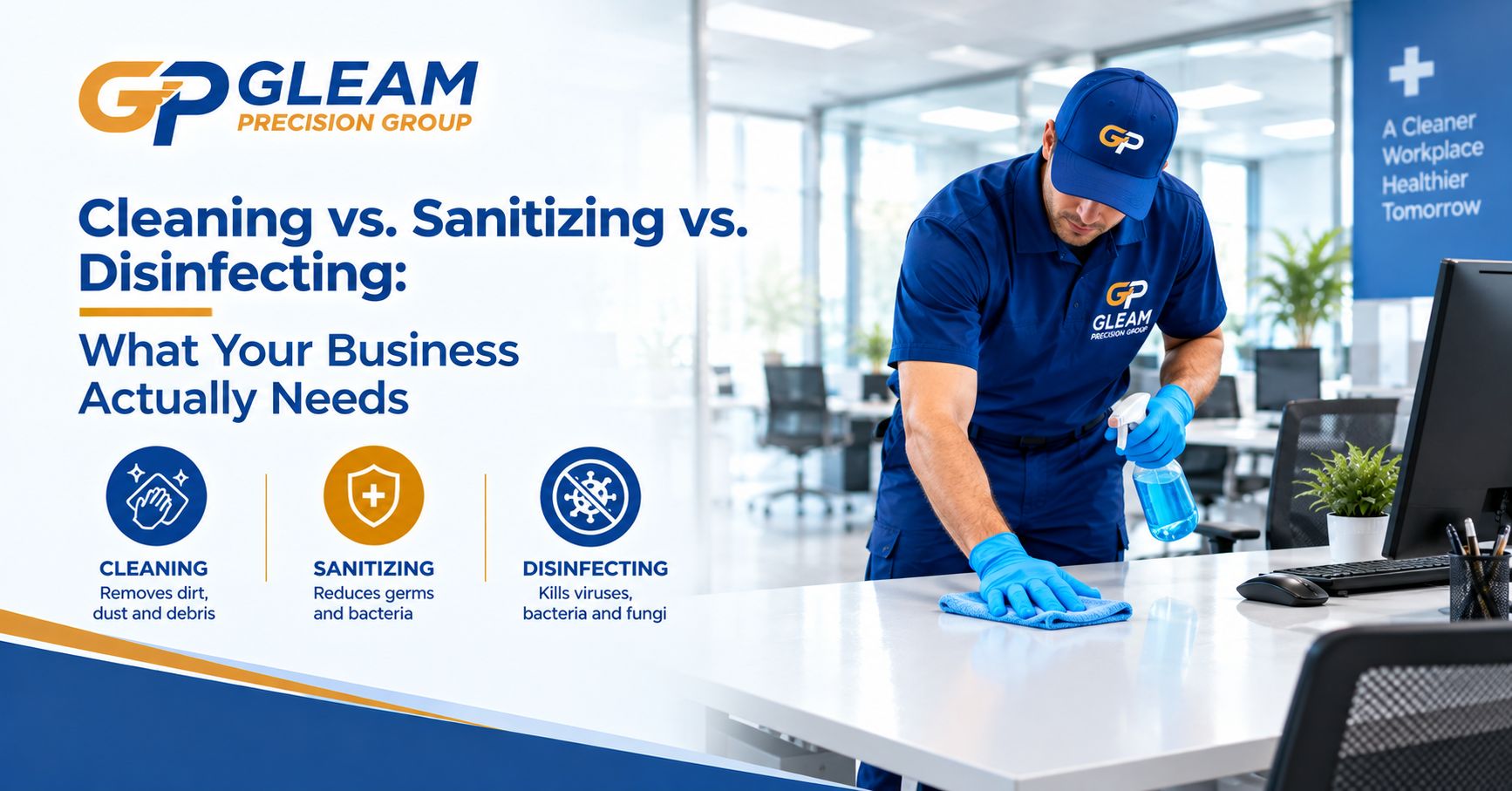
Cleaning, sanitizing, and disinfecting are three different processes used to maintain hygiene in commercial spaces. Although people often use these terms interchangeably, each serves a distinct purpose. Cleaning removes dirt and many germs, sanitizing reduces germs to levels considered safe under applicable public health standards, and disinfecting uses specific products to inactivate or destroy germs on surfaces according to label directions.
Businesses do not necessarily need to disinfect every surface all day. The right approach depends on the type of workplace, how people use the space, the surfaces involved, and the risks associated with contamination.
For businesses seeking a cleaner, more professional environment, understanding these differences makes it easier to create an appropriate maintenance plan. Gleam Precision Group provides a starting point for exploring cleaning solutions suited to commercial environments.
This guide explains what each process does, when businesses may need it, and how to decide which cleaning method belongs in your workplace routine.
Cleaning is the process of removing visible dirt, dust, debris, grease, spills, and other unwanted material from surfaces. It typically involves water, detergent or another suitable cleaning solution, and physical action such as wiping, scrubbing, or mopping.
Cleaning can also remove many germs from surfaces. However, it does not automatically kill or inactivate every microorganism present.
Routine cleaning is necessary in almost every commercial environment. Common examples include:
For example, an office may need desks wiped, floors vacuumed, washrooms cleaned, and shared kitchen counters washed as part of its regular maintenance schedule. These tasks help maintain appearance, reduce the buildup of soil, and support a comfortable working environment.
Businesses looking for structured commercial cleaning services can use a cleaning schedule to ensure that routine tasks are completed consistently.
Dirt and organic material can interfere with the effectiveness of some sanitizing and disinfecting products. Cleaning a surface before applying a product is therefore important unless the product label specifically permits a combined cleaning and disinfection process under the conditions of use.
A surface that looks clean is not necessarily free from germs. Likewise, a surface that has been disinfected may become contaminated again when someone touches it. Cleaning is an ongoing process, not a one-time solution.
Also Read:
How to Choose a Medical Facility Cleaning Company in Ontario
Sanitizing reduces germs on a surface to a level considered acceptable under applicable public health requirements or product standards. It is often associated with food-contact surfaces and environments where hygiene is particularly important.
Sanitizing is not simply another word for wiping a surface. A sanitizer must be suitable for the intended surface and used according to its label directions, including any required contact time.
Sanitizing may be appropriate in situations such as:
Consider a workplace break room where employees prepare meals and wash dishes. Countertops, utensils, and other food-contact items may need cleaning followed by sanitizing, depending on their use and the applicable requirements.
A general-purpose household or commercial cleaner should not automatically be treated as a sanitizer. Check the product label to confirm its intended use, approved surfaces, dilution requirements, and contact time.
No. Sanitizing is intended to reduce microorganisms to a specified or accepted level, but it does not mean that every type of germ has been eliminated. Its effectiveness depends on the product, the surface, the application method, and whether the directions are followed correctly.
Sanitizing is therefore useful for specific hygiene needs, but it is not a universal replacement for cleaning or disinfection.
Disinfecting involves using an appropriate product to inactivate or destroy specified microorganisms on surfaces. The organisms a product is effective against depend on its formulation, testing, regulatory status, and label claims.
Disinfectants are often used on high-touch surfaces or in situations where a greater level of microbial control is warranted.
Depending on the setting and risk assessment, disinfecting may be appropriate for:
For instance, a business may increase attention to shared touchpoints during an illness-related concern or after a contamination incident. The exact response should reflect the type of contamination, workplace policies, and relevant public health guidance.
Businesses that need a more detailed approach to maintaining office hygiene can explore professional office cleaning services and establish clear procedures for routine cleaning and any necessary disinfection.
Many disinfectants must remain visibly wet on the surface for a specified period to achieve their labelled effectiveness. This is known as the contact time or dwell time.
Wiping a product off immediately may prevent it from working as intended. Staff should follow the label's instructions for:
Never mix cleaning chemicals unless the manufacturer explicitly instructs that they can be combined. Mixing products can produce dangerous fumes or other hazardous reactions.
| Feature | Cleaning | Sanitizing | Disinfecting |
|---|---|---|---|
| Main purpose | Remove dirt, soil, and debris | Reduce germs to an accepted level | Inactivate or destroy specified germs |
| Typical method | Detergent, water, and physical action | Approved sanitizer used as directed | Approved disinfectant used as directed |
| Removes visible dirt | Yes, when performed effectively | Usually requires prior cleaning | Usually requires prior cleaning |
| Intended germ control | Removes many germs but may not kill them | Reduces germs to the required level | Targets specified microorganisms |
| Common applications | Floors, desks, counters, general surfaces | Certain food-contact surfaces and designated settings | High-touch surfaces or specific contamination risks |
| Replaces routine cleaning? | It is the foundation of routine hygiene | No | No |
The key takeaway: cleaning addresses dirt and soil, sanitizing reduces germs to an accepted level, and disinfecting targets specified microorganisms. The best method is the one suited to the surface, environment, and actual hygiene requirement.
Also Read:
Ontario Office Cleaning Checklist: What Every Business Owner Should Know
There is no single method that is right for every room, surface, or business. A practical workplace plan uses routine cleaning as its foundation and adds sanitizing or disinfecting when appropriate.
Most offices benefit from scheduled cleaning of desks, floors, meeting rooms, reception areas, washrooms, and kitchens. Shared touchpoints may require additional attention based on usage and workplace risk.
Disinfection may be appropriate when a workplace protocol, specific contamination event, or applicable public health recommendation calls for it. Disinfecting every surface repeatedly is not automatically better if the process is unnecessary or products are used incorrectly.
Retail environments experience regular contact with door handles, counters, payment terminals, and shared fixtures. Frequent cleaning helps maintain presentation, while targeted disinfection may be appropriate for selected touchpoints according to the circumstances.
The schedule should account for customer traffic, operating hours, surface compatibility, and the instructions for any products used.
Food service environments may require cleaning and sanitizing procedures for food-contact surfaces, utensils, and equipment. Requirements depend on the activity, local food safety rules, and the surface involved.
Disinfection and sanitizing are not interchangeable. A disinfectant should not be used on a food-contact surface unless its label permits that use and all specified rinsing or other requirements are followed.
Healthcare facilities and certain specialized workplaces may require more stringent procedures, approved products, training, and documented protocols. The appropriate process depends on the setting, the microorganisms of concern, and applicable regulations or public health guidance.
A general office cleaning checklist is not a substitute for a facility-specific infection prevention procedure.
Warehouses, workshops, and industrial spaces may need regular removal of dust, grease, and production residues. Floor care and cleaning methods must also account for equipment, traffic patterns, chemical hazards, and slip risks.
Depending on the site, janitorial services can help organize recurring tasks, while specialized work may require additional procedures and equipment.
A good hygiene plan should be easy to understand, realistic to maintain, and specific to your business.
Make an inventory of the areas that require attention, including floors, desks, washrooms, break rooms, reception counters, shared equipment, and food-contact surfaces.
Consider who uses each area and how frequently it is touched.
Not every surface needs the same schedule. Frequently used washrooms and shared touchpoints may require more frequent attention than a lightly used storage room.
Create a written checklist that identifies the task, frequency, responsible person, and required product or equipment.
Read labels carefully. Confirm whether a product is a cleaner, sanitizer, disinfectant, or a product with multiple approved uses. Check that it is appropriate for the surface and the intended application.
Use only the concentrations and application methods specified by the manufacturer.
Employees should understand the difference between cleaning, sanitizing, and disinfecting. Training should cover chemical handling, contact times, protective equipment, ventilation, storage, and procedures for spills or contamination incidents.
Staff should also know when a task falls outside their training and requires a supervisor or specialist.
Business operations change. New equipment, higher occupancy, seasonal conditions, or a contamination incident may require changes to the cleaning schedule.
Review the plan regularly, document completed tasks where appropriate, and correct gaps rather than relying on appearance alone.
Professional cleaners can help businesses maintain consistent routines and identify tasks that need specialized equipment or procedures. Depending on the facility, additional services may include deep cleaning, carpet cleaning, floor cleaning, and window cleaning.
These services address different maintenance needs. They should complement, not automatically replace, a business's specific sanitation or disinfection requirements.
Even a well-intentioned cleaning routine can fall short when procedures are unclear. Watch out for these common mistakes:
The solution is a documented, risk-based plan supported by suitable products, staff training, and regular review.
Also Read:
Commercial Cleaning Costs in Ontario: Pricing Factors Every Business Should Know
No. Cleaning removes dirt and many germs from surfaces, while disinfecting uses a suitable product to inactivate or destroy specified microorganisms. Cleaning is often necessary before disinfection.
Neither is universally better because they serve different purposes. Cleaning is the foundation of routine hygiene. Sanitizing is appropriate when a surface or setting requires a reduction in germs to an accepted level.
Not necessarily. The required frequency depends on the workplace, surface use, contamination risk, applicable guidance, and business-specific procedures. Some surfaces need regular cleaning, while disinfection should be used when appropriate.
Some products are labelled for both cleaning and disinfection under specified conditions. Others require a separate cleaning step first. Follow the exact product label rather than assuming that all disinfectants can remove soil effectively.
An office should first maintain consistent routine cleaning. Additional sanitizing or disinfection should be based on the surfaces involved, workplace risks, relevant guidance, and product directions.
Start by identifying high-use areas, setting realistic task frequencies, choosing appropriate products, training staff, and checking that tasks are completed correctly. Professional cleaning support can help maintain consistency.
Understanding cleaning vs. sanitizing vs. disinfecting helps businesses make informed decisions about workplace hygiene. Cleaning removes dirt and debris, sanitizing reduces germs to an accepted level, and disinfecting targets specified microorganisms when additional control is needed.
For most workplaces, the best approach is not to apply every method everywhere. It is to build a consistent cleaning routine, identify higher-risk areas, follow product directions, and use sanitizing or disinfecting procedures when the situation calls for them.
By matching the method to the task, businesses can maintain cleaner facilities, use cleaning products more responsibly, and support a more professional environment for employees, customers, and visitors.